Persephone’s Story: The Healer’s Journey as The High Priestess
Are you a healer or an aspiring healer? Learn how Persephone’s Story is The Healer’s Journey of transformation, even in the face of trauma.
Many healers share a similar life story—it’s the details that differ. For some, it begins in childhood; for others, later in life. The pattern often unfolds like this: a profound wounding occurs—trauma, heartbreak, grief—and they are pulled into a period of deep darkness. It’s hard. They struggle. They endure. And somehow, they manage to crawl out of that darkness toward empowerment.
In the process of healing, they uncover parts of themselves they never knew existed. Through their trials and tribulations, they discover practices and modalities that transform their lives. And it is through this journey that they become healers—compelled to share what they’ve learned with others.
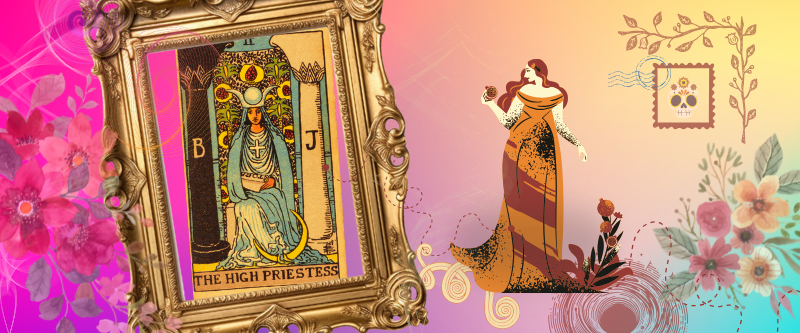
The High Priestess in the tarot represents this journey. On the surface, The High Priestess is about intuition, inner guidance, and tapping into an innate wisdom beyond intellectual knowledge — which is already quite a lot to unpack! Beyond that, as depicted in the traditional Rider-Waite Smith tarot decks, The High Priestess sits in her stillness, and behind her is a tapestry of Pomegranates, representing Persephone — who is both the Greek Goddess of Flowers / Spring, and Queen of the Underworld.
Between Two Worlds: The Duality of Persephone and The High Priestess
Persephone represents the duality of The High Priestess, just as the black and white columns beside her, and the crescent moon by her feet, represents the betweenness of two worlds: The conscious and the subconscious / unconscious, the seen and unseen, light and dark.
In our binary world of ‘black and white’, you’re ‘in’ or you’re ‘out’, you’re ‘yes’ or ‘no’ — this idea that one could be two seeming opposing concepts as the “Goddess of Flowers” and The Queen of the Underworld kinda blows the mind. It’s like saying you’re both a barbie girl, and a goth girl at the same time — yet, this is exactly the mind-bending perspective change that Persephone invites us into.
Persephone’s story is one of transformation and highlights the cycles that healers take towards wholeness. This is what makes Persephone’s story so resonant, especially for healers, which is also represented by The High Priestess. Persephone’s story is the healer’s story.
Persephone’s Myth in Brief
I learned from Persephone’s Pathway by Jennifer Heather that there are many versions of Persphone’s Story. And I will tell the version that most resonates with me. (Feel free to choose the details that most resonate with you! It may change over time as we evolve as well.)
As the myth goes…
Persephone was a young maiden, a good girl, innocent. In this phase, she’s sometimes known as Kore. Kore was out picking flowers when the Earth opened up and Hades, God of the Underworld, kidnapped Kore and brought her to the Underworld to make her his bride.
Her mother, Demeter, Goddess of the Harvest went searching and was distraught when not being able to find her, reached out to Zeus for help. Zeus at first denied her request, and in her rage and grief, Demeter allowed the land to fallow, and all the crops in the land died, causing famine across the lands.
Zeus, could not let this happen again, and ordered Hermes, the winged messenger to fetch Kore from the Underworld. Before Kore left, Hades offered her pomegranate seeds, which she ate. Upon eating the pomegranate seeds, she was bound to the Underworld. Zeus negotiated with Demeter and Hades and announced that Kore, (who has now become Persephone), will spend half of the year in the Underworld with her husband, Hades, (as Queen of the Underworld) and half the year in the Upperworld with Demeter (as Goddess of Spring / Flowers).
A Myth is in the eye of the beholder
There are many details of this story that can change depending on the teller. Remember that this is a myth, so there are no ‘facts’ — only a story that evolves depending on the storyteller.
Details such as – Was Persephone forced to marry Hades, or did she consent? Was she tricked to eat the pomegranate seeds, or did she decide to eat them with her own free will? One version of the myth explores Persephone’s relationship with Demeter, suggesting that Persephone felt stifled by her mother. In this telling, her journey to the Underworld becomes an act of rebellion—a way to break free and claim her own identity. It adds a “loving-yet-defiant” complexity to their bond, as many mother–daughter relationships do.
Whatever version speaks to you, certain core elements remain. Persephone begins as an innocent girl who undergoes a trauma that draws her into darkness. Through this experience she loses that innocence and emerges as a woman. When she returns to the Upperworld, she carries the wisdom she gained and shares it with the world—her gift—manifested as springtime and flowers.
This cycle reflects both Divine Feminine energy and the healer archetype (regardless of gender)—a journey of descending into darkness and then re-emerging, much like death and rebirth. While death and rebirth often symbolize a shift in identity (which Persephone experiences), the story also mirrors the process of healing and becoming a healer.
Many healers venture into ‘Nine or Ten of Swords-type’ dark night of the soul times—through an experience that takes them there, or through emotional depression or anxiety—delving deep into the subconscious to uncover root causes. They heal, release, and excavate what has been buried so it can finally be set free.
This is the path: to enter the darkness, find our way through it, heal ourselves, and then return to the surface carrying hard-won wisdom—ready to guide others.
“Every human will experience trauma to varying degrees within their life, and a Goddess like Persephone demonstrates that we can emerge reborn from the abyss of darkness. She teaches us that some chapters have to end in order to make space for new beginnings”
-Jennifer Heather, Author of Persephone’s Pathway
My Persephone Story: How Descent Shaped My Becoming
When I think of Persephone’s story, I can’t help but recall my late twenties, when I was swept up in a toxic relationship. I fell hard for a man who was volatile and vengeful—but of course, that’s not how it began. At first he made me feel protected, a “can-do” kind of guy who seemed ready to rescue me whenever life felt overwhelming.
On one of our first dates we ate at an Italian restaurant. He buttered bread for me, and I remember thinking how astonishing it was that a man would do that. To him it was a simple, loving gesture; to me it felt like rare care and affection—something I hadn’t experienced in a long time.
We fell for each other fast and hard, and he soon shared a life story full of tragedy and trauma—a depth of intimacy I’d been craving. But he also told stories of taking revenge on people who’d wronged him. Red flag? Absolutely. As fierce feelings surged through me, it was like I was drowning, just like Persephone being pulled into the Underworld; even though I saw the flags waving, I was caught in the under toe of intense emotions I was experiencing.
I clearly remember a choice I made that was the moment I ate the pomegranate seed. A few months into the relationship, we were driving through San Francisco when another car cut him off. He exploded with rage and started tailing the driver. I told him to stop, but he wouldn’t listen. Finally, he swerved ahead, blocked the car, and shouted obscenities until the other driver sped away.
After an awkward silence, he said, “This is who I am. I have this streak in me. You can leave if you want—I won’t hold it against you.”
I stood there for a few minutes, torn in two directions. Part of me knew I should walk away, but another part refused to let go—and that part won. I hugged him and said I wanted to stay.
That moment of commitment set off three years of extreme highs and lows. We broke up and got back together repeatedly. His volatility and darkness drew out my own. When we would break-up he would be intentional in the ways he would do it, in order to make it hurt the most, and eventually I began doing the same in return—it became a cycle of mutual emotional manipulation.
Ironically, what finally ended us was trivial compared to the truly awful things we’d done to each other. One morning over breakfast we were planning a vacation. I wanted to go to Europe; he wanted to go to Disneyland. He went on and on about how fun Disneyland is and couldn’t understand why anyone would choose Europe.
The gears in my mind started turning: Do I really want to be with someone who’d rather go to Disneyland than Europe? Is this the kind of partner I want? That simple thought triggered a full review of our relationship, and I finally realized: we are very different people.
The gifts that came to surface
They say that when Persephone resurfaces from the Underworld, she always brings back gifts: insight, healing, wisdom. For me, though, those gifts took years—if not decades—to emerge, and continue to do so.
When the relationship ended, I was heartbroken, traumatized, and exhausted. All I wanted was stillness and quiet. At the time, I was an atheist with no sense of faith or “higher power” to lean on. All I had were my two cats and the calm of a new apartment in a San Francisco suburb—where I moved after my ex had tried to break into my old place.
About a year later (after more work trauma—sigh), I began to seek spiritually. I bought my first tarot deck and read many books on intuition. I started somatic therapy and saw a Reiki master regularly.
I still remember my first professional tarot reading. The reader pulled the Six of Swords—the image of a woman fleeing in a boat. “Moving from turbulent waters to calmer ones,” he said. That message hit me in my bones. Slowly but surely, I began to heal.
Over the years, many gifts have surfaced—some so subtle I may have forgotten them by now. As painful as that time was, I can honestly say (sappy and cliché as it sounds) that I’m grateful I went through it, because it shaped me into who I am today. Here are a few of those gifts:
1) He gave me the opportunity to empower myself
First and foremost, that relationship forced me to rise up, step into adulthood, and reclaim my power. Just as Kore, the innocent maiden, became Persephone through her descent, I too eventually pulled myself out of the relationship (even if it took more than a few tries).
I had given my power away to the relationship because I believed I was weak, even before we got together. This relationship gave me the opportunity to rise up, so that I could uncover what was actually inside of me: strong, capable, resilient, empowered. I had been terrified of the world and thought I needed him to protect me from it. Now I know that I didn’t need him to protect me, I could do it myself.
2) He made me feel again
After much therapy and healing, I realized that due to fear of judgement of being an emotional child, I suppressed my feelings. The intensity of our relationship jolted my emotional system. I felt love, but I also felt all the other not-so-pleasant feelings such — anger, resentment and jealousy, which as I eventually learned, are not all bad feelings — but signals.
For so long I had relied on my survival mechanism of staying analytical, and it left me disconnected from my emotional body. That relationship—however painful—shocked me back into feeling, and embarked on a journey to work with my emotions rather than suppress them.
As Brené Brown says: “We cannot selectively numb emotions. When we numb the painful emotions, we also numb the positive emotions.”
3) He brought the darkness within me to light
At the time, I saw myself only as a victim. For years, I called what I went through emotional abuse. Now, I call it emotionally toxic—because I participated too.
Debating who was “meaner” misses the point. What matters is that it wasn’t about him—it was about me. My choices. My actions. My responsibility. I have to own my part, just as he has to own his. I am responsible for my soul; he is responsible for his.
We usually grow up being taught a set of morals. “Be good,” they say. Wanting to belong and be loved, we strive to be “good.” I built an identity around being the “good girl,” convinced there was no way any darkness lived inside me.
But when he drew that darkness out, I finally saw it—and what I was capable of. My acts of spite, manipulation, and vengefulness revealed parts of myself I had never acknowledged. Now, as I work toward healthier relationships, I stay mindful of those parts. I question my motives and intentions, choosing actions rooted in love instead.
We can’t truly do this without facing those hidden parts, because they, too, are survival mechanisms born from fear. They are the cries of the inner child asking to be seen and healed. The healer within us tends to that child, nurturing the parts that need care.
“Dark Goddess energy has been ignored for a long time in favour of the ‘love and light’ approach. This school of thought puts a focus on positivity and avoidance of negativity, when in reality, we need both to be balanced.”
-Jennifer Heather, Author of Persephone’s Pathway
In Healing Ourselves, We Become Healers
This cycle of descending into the dark and returning with light becomes part of the cycle of transformation that we’re more willing to engage with, and it gets easier. Once we’ve felt the effects of healing—freedom, authenticity, the ability to love ourselves and others more—it no longer feels as overwhelming. We’ve gained the tools to move through it. We understand that the dark isn’t something to avoid; it’s a necessary part of the healing process.
Every healer finds their own modality. It might be Reiki, yoga, tarot, tapping/EFT, acupuncture, meditation, hypnotherapy, shamanism, somatic therapy, energy work, crystal healing, massage, or past-life healing—the list is endless. We discover what works for us, and then we feel called to share it with others.
The Divine Feminine within us reminds us that we are always shifting and changing. The High Priestess recognizes this constant cycle and honors the Persephone within us—integrating darkness and shadow into wholeness.
The Empress, who follows the High Priestess as card number three in the Major Arcana, is her more earthy counterpart. She wears a gown patterned with Persephone’s pomegranates, symbolizing her devotion to the natural cycle of death and rebirth and the fruit of abundance as a result.
Each time we descend into the darkness, something within us dies—an identity, a way of being, a behavior, or a limiting belief. And each time, we are reborn into the flowers of spring: into self-acceptance, self-love, wisdom, and the freedom to live as our true, authentic selves.
May it be so, and may you courageously travail The High Priestess’s Journey with heart, grace and true empowerment. 💜
Wanna dive deep with The High Priestess?
Come Journal about it!
Join us in Journaling with Tarot, every Tuesday at 2 PM Pacific on Zoom,
We feature a different tarot card every time! It’s a place of learning, self-discovery, and community.
Plus — it’s free / donation-optional! Learn More
Missed the High Priestess class? Join the Tarot Journey Membership to access all replays.

Journaling with Tarot
Tuesdays @ 2 PM Pacific
Weekly & Free on Zoom!
Tarot learners of all levels are welcome.
Can’t come to every class?
Join The Journey Circle Membership!
Subscribe to our newsletter!
Get updates on the latest articles, class schedules and more.