Working with the Shadow in Tarot through Reversals

I know the word ‘shadow’ sounds scary. But the Shadow, or Shadow work can be one of the most powerful self-discovery tools in a healing toolkit.
First off, What is the Shadow?
In short, the Shadow are parts of ourselves that we hide, deny or disallow. They are parts of us that we deemed ‘bad’ — due to a myriad of factors including judgement, childhood wounding, or childhood programming.
In many ways, the Shadow is a survival mechanism — we squish down these parts of ourselves, because it wasn’t safe to show, or due to an innate desire to belong. In hiding them from others, we hide them from ourselves. Seeing the shadow can be hard because it often comes from a wounded place that wants to be acknowledged.
We didn’t lock this part away because we’re bad people. In fact, in many ways, it shows the ingenious part of our psyche! By hiding what is scary or unsafe at a certain time in our lives, we keep ourselves safe and surviving.
When we’re ready to empower ourselves by acknowledging our sovereignty as adults, that’s when we do shadow work to free ourselves in order to uncover our authentic selves!
A common example of the Shadow: Anger
Anger is one of the most common shadows we carry. For many of us, early experiences taught us to repress it — maybe a parent’s anger felt unsafe, or perhaps no one modeled a healthy relationship with anger at all. Either way, we internalized the belief that anger is “bad” and pushed it into the shadows.
But what’s repressed doesn’t vanish. Anger bubbles beneath the surface. We may project it onto others, labeling them as “angry people,” or turn it inward, judging ourselves when it inevitably leaks out.
Shadow work asks us to meet anger differently. Instead of seeing it as good or bad, we recognize it as information. When we engage with this deep work, we begin to see our behaviors and, therefore can choose to act in a way that resonates with our truth. Instead of denying our anger, and letting it ‘come out bad’, we can see that we’re triggered, and ask ourselves what’s trying to be communicated. When we practice this type of mindfulness, we can change our relationship with anger, as well as our relationships with our loved ones.
Why should I care about my Shadow?
It takes a lot of energy to hide all of these parts of ourselves that we don’t want seen. The more we repress it, the more it bangs on our emotional door through triggers, fears and anxiety.
To finally allow ourselves that self-honesty — to see it, name it, own it, and put it on the table is incredibly freeing. As in the anger example — have you ever admitted you were angry after trying to pretend you’re not? And when you finally let yourself have that anger, did you feel lighter and freer? All of the energy we use to hide the anger from ourselves is tiring, and anxiety-producing. As scary it is to face the anger, we let go of it (even if it’s bit by bit).
This is the power of shadow work, and it can be transformational. It’s a self-discovery tool that frees us from what we think we should or should not be, based on other people’s perceptions — rather than our true loving selves.
Why Shadow Work is more important than ever before
I believe that the world is one giant mirror. And what I see out in the world right now is quite a lot of shadow — a denial of the self, due to deep wounds that go unacknowledged. That’s the thing with the Shadow — the shadow is not inherently bad. But when unacknowledged, it may cause us to behave in ways that show the darkness of our egos. (eg: In the case of anger, we may erupt or be passive aggressive, or take out our anger in ways that we’re unconscious of.)
When we do this important inner work, we become more loving — towards ourselves, and in turn, towards others, because we’re no longer holding onto what was denied. We become mindful of our behaviors, and transmit less pain out into the world. This is work that has a butterfly effect, that is about finding the source of the pain and healing it, rather than simply addressing the symptoms of the pain.
How do reversals uncover our Shadows in Tarot?
Reversals are tarot cards that are pulled upside down. And if we choose to work with it in this way, it highlights a resistance or unbalance when it comes to the essence of the card. In this way, reversals are bringing to light fears and blocks, and shows us the shadow that we’re not seeing.
Many reversals in Tarot resources are written in a way that can feel critical or negative, when truly, shadow work is not about berating ourselves, but rather acknowledging a part of us that wants to be seen, tended to, and loved.
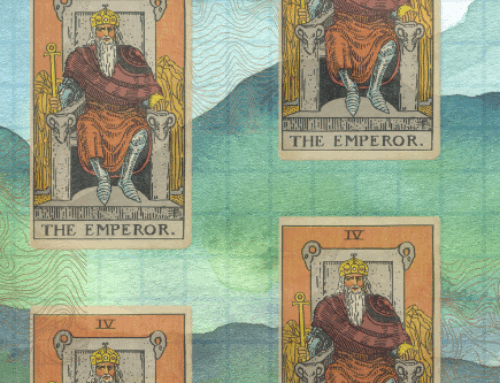
For example, The Emperor reversed is all about domination, control, and stubbornness, and it is a prevalent theme in today’s society right now. This sounds villainous, and perhaps it can be, especially in today’s world (because that’s how it feels!). But for those of us who are everyday people trying to be good people in the world, being controlling can very much be one of our shadows. As good people, we may have an ideal way we think the world should be, and think: “I know what the world needs! If the world could just be this way or that way, then everyone can be okay,” without realizing that, when mixed with perfectionism, is also a form of control.
This control inside often comes from a wounded place, that wants compassion. Perhaps there was not a healthy structure in our childhoods, or we were taught always be in control — and that if you’re not in control, then you’ve failed. Many of us have a version of this type of limiting belief system within us. And for a long time, we used it as a survival mechanism to stay safe. “If I could just control my environment, my situation, I’ll be okay.”
Shadow work is about acknowledging “Yes, I am controlling, because I needed to. And now, I am an adult and living in a different situation, I can change and give myself permission let go of the control.. even if it’s just a bit.” As we heal, we may find other parts of ourselves — parts that want to trust, have faith, allow, which are actually more true to our deep authentic selves.
This is ownership for the self. And the world right now is need of accountability, truth and freedom. It begins with us.
Join us in Journaling with Tarot, every Tuesday at 2 PM Pacific on Zoom,
where we will be diving into the shadow of each card. It’s a place of learning, self-discovery, and community.
Plus — it’s free / donation-optional! Learn More
Wisdom & Quotes about the Shadow from Spiritual Teachers
“In the shadow we find the keys to self-acceptance. Every quality we disown in ourselves turns into one of the many demons that torment us. By embracing our shadows, we reclaim the energy that has been bound up in judgment, fear, and shame.”
—Debbie Ford
“Your shadow is all of you that you were taught to reject, repress, and deny. It is not evil; it is simply the parts of you that have been waiting to be seen, loved, and integrated.”
—Xavier Dagba
“The shadow is the place within us that contains all the unhealed wounds, all the things we have disowned, all the darkness we project onto others.”
—Marianne Williamson
“The shadow is not only the repository for what is negatively judged in us, but also for the gold we have not yet discovered. The golden shadow contains our hidden talents, our unrealized potential, and the aspects of our being that we have not yet dared to live.”
—Robert A. Johnson

Journaling with Tarot
Tuesdays @ 2 PM Pacific
Weekly & Free on Zoom!
Tarot learners of all levels are welcome.
Can’t come to every class?
Join The Journey Circle Membership!
Subscribe to our newsletter!
Get updates on the latest articles, class schedules and more.